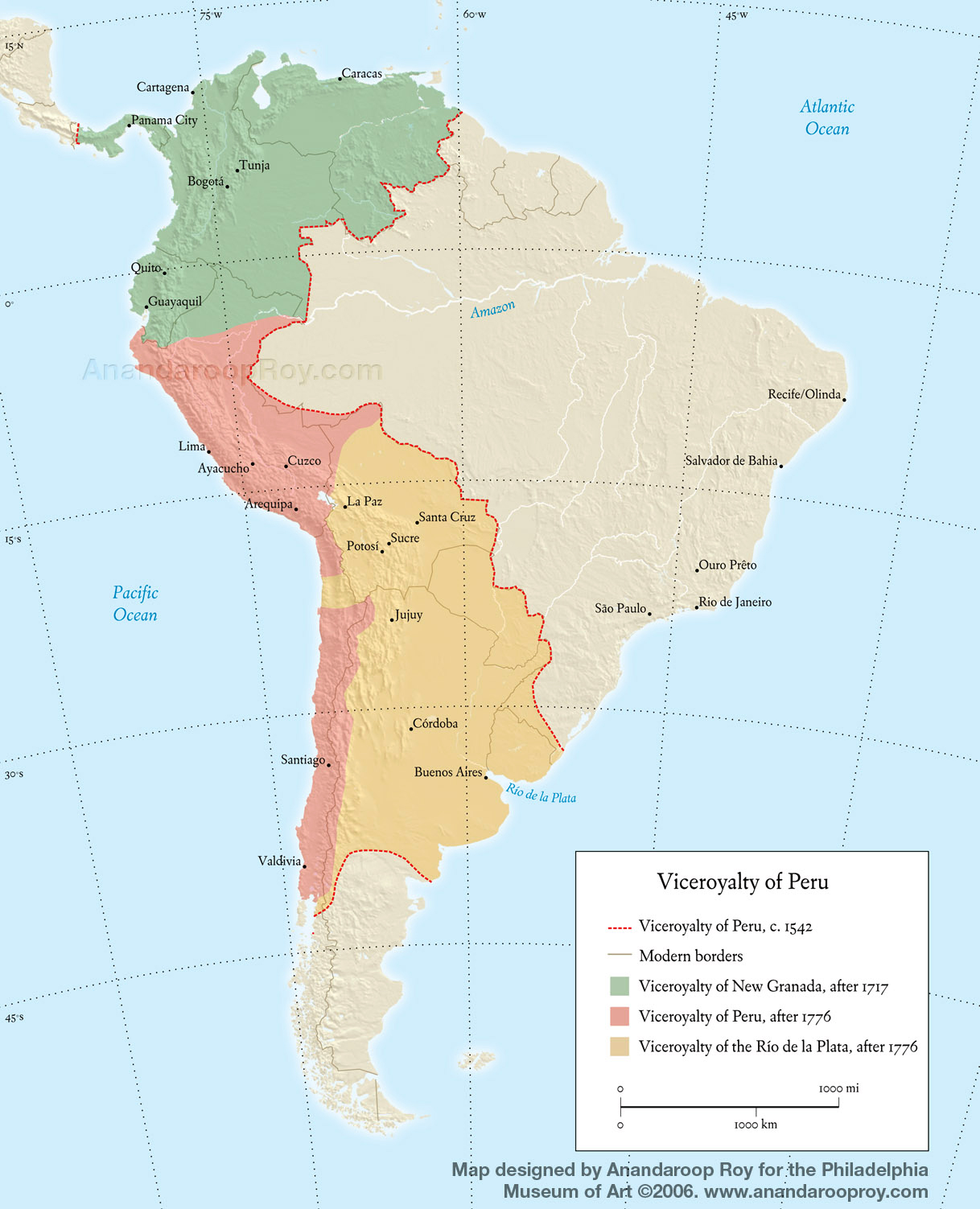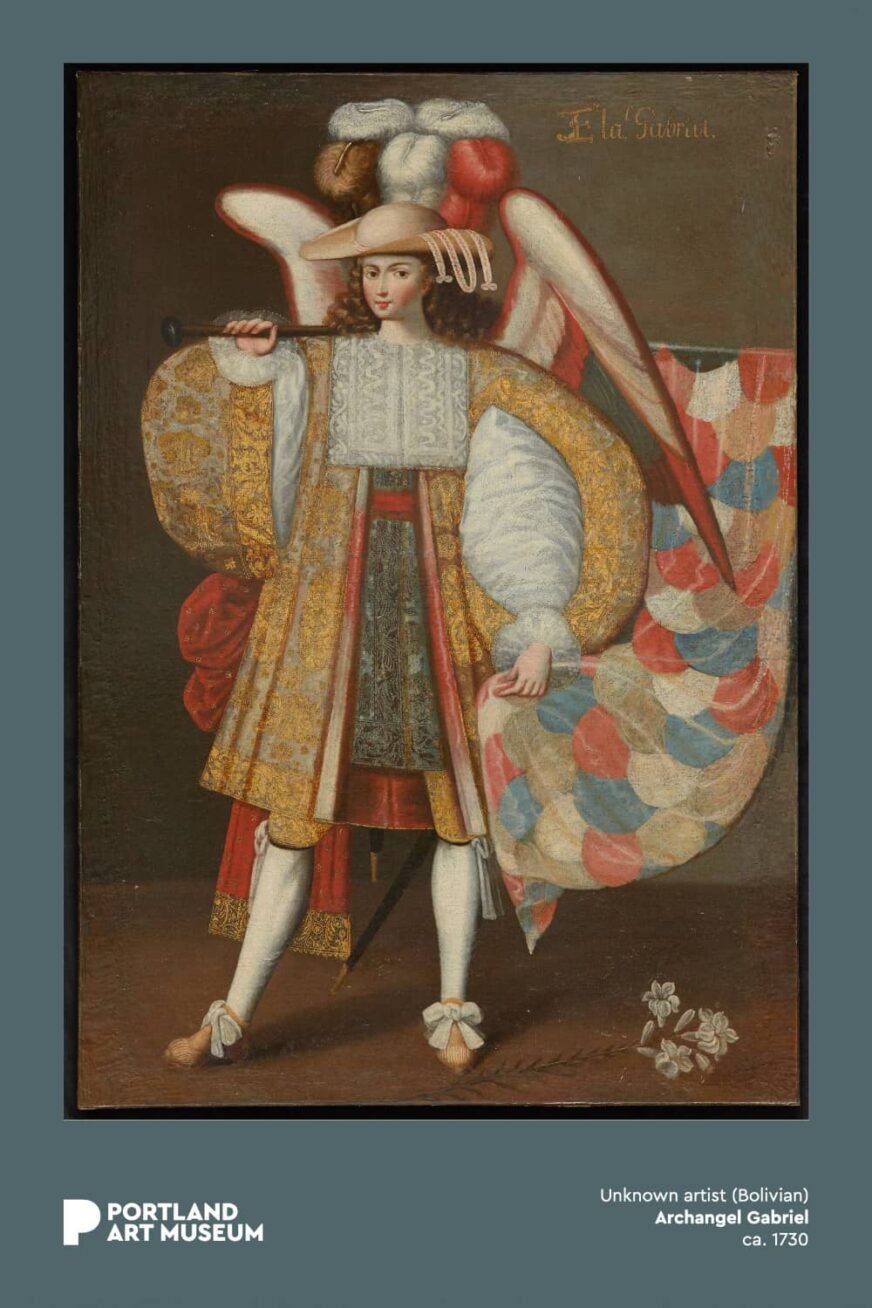
This glorious image of the Archangel Gabriel represents an artistic tradition rarely present in U.S. museums but familiar to millions from Peru, Chile, Bolivia, Ecuador, Guatemala, and Mexico. The artist lived in the city of La Paz (in present-day Bolivia) in the Andes Mountains during the Spanish viceregal or colonial period (1521–1821) when Spain ruled Central and South America. The Spanish viceroyalties were culturally complex and diverse societies that encompassed Indigenous, European, Asian, and African peoples. In La Paz, a city established by Spain on the site of the Incan settlement of Laja, artists and artisans applied their skills to the new religion of Christianity, producing an iconography and style completely new and reflective of the interaction of Indigenous and European cultures.
The figure of the Archangel Gabriel nearly fills the frame of this large painting with ornate puff sleeves, a tall plumed hat, a wide colorful banner, and long tapered wings. Gabriel is an angel represented in the Christian Bible as a messenger sent from God to Mary to announce that she would conceive and give birth to Jesus. Gabriel is an archangel or leader of angels, who formed God’s heavenly army. Large, powerful paintings of archangels became popular in Christian churches in Peru and Bolivia in the 1600s. They were seen as a comforting group of powerful, supernatural figures sent by God to minister to believers. How do we know this one is Gabriel? His name is helpfully written on the painting, “El a[rcange]l[o] Gabriel,” but additionally each archangel has a symbol, and Gabriel’s was a white lily, a reference to Mary’s purity and virginity.
The Spanish brought Christianity to this region when they defeated the Incan empire in the 1500s, and European missionaries worked hard to convert Indigenous peoples to their religion and its stories with the help of prints and images. This area in the Andes mountains had been home to a sophisticated artistic culture that was centuries old, and Indigenous artists adopted the new imagery in ways that created whole new artistic traditions not present in European churches, such as the series of archangels. The artist is not named, but his style is distinctly different from European style of the 1600s. The bright colors, and strict patterns of these paintings stayed popular in this area for centuries.
In their Christian paintings, these artists did not include any of the imagery we see on Incan-empire art. Missionaries and colonial rulers had actively sought to put an end to traditional Incan imagery. Instead these artists applied their knowledge and creativity to inventing new religious figures in a new style that reflected the energy and values of both Indigenous and European artistic traditions. In Gabriel, we see them creatively combining two of the plentiful, inexpensive and highly portable prints the missionaries brought in large quantities. A soldier from a Dutch book about handling guns is combined with Gabriel from a set of prints of all eight archangels. Ostrich feathers were often used by European soldiers to decorate helmets, but the Andean-mountain artist of Gabriel greatly multiplied the feathers, and probably based his feather on those of the local Rhea, an ostrich-like bird. The flag Gabriel carries (instead of a gun) is made of feathers, and resembles the large luxurious Incan textiles that were traditionally made in this region using brightly-colored feathers.
Discussion and activities
- Spend several minutes looking closely at the image on the front of the poster. How many details do you notice? Make a list of 10 details and share it with a partner. How would you describe this figure? What about the figure is familiar to you and what is surprising or new?
- Look closely at the depiction of wings in this painting and study the wings of various bird species. Then, create your own artwork showing an imaginary being with wings. Why did you depict the wings as you did? To extend the activity, research representations of winged figures in mythology, such as the Incan Amaru, Aztec Quetzalcoatl, or Greek Hermes. Write a story about your imaginary being.
- The white lily in this painting is a Christian symbol for “Mary’s purity and virginity.” What symbols do you see in your everyday life? Look around your home and choose a symbol to describe. What does it mean to you and/or your family?
- Art historian Ananda Cohen-Aponte writes, “The visual arts of the colonial Andes stand as a testament to the resilience of native peoples in the post-conquest world. Native Andeans continued to express themselves artistically alongside and in collaboration with Spanish, mestizo, criollo, Asian, and African-descended peoples.”* Where do you see evidence of “dynamic contact” or cultural hybridity in this painting? Identify elements in the painting that suggest European Christian as well as Indigenous Andean influences. Think of examples of cultural hybridity or exchange in our world today. Share an example of a work of art–visual or any other art form–that is hybrid.
* Dr. Ananda Cohen-Aponte, “The Viceroyalty of Peru, an introduction,” in Smarthistory, October 16, 2020.
Selected sources
Highest Heaven: Andean Art from the Elvin Duerst Bequest online collection. Portland Art Museum.
Dr. Lauren Kilroy-Ewbank, “Defensive saints and angels in the Spanish Americas,” in Smarthistory, February 22, 2021.
Dr. Ananda Cohen-Aponte, “The Viceroyalty of Peru, an introduction,” in Smarthistory, October 16, 2020.
Maniement d’armes, d’arqvebuses, mousqvetz, et piqves. 1608. Internet Archive.
- French translation of Jacob de Gheyn’s 1607 De Wapenhandelinghe (The exercise of arms), a source for the painting of the Archangel Gabriel.