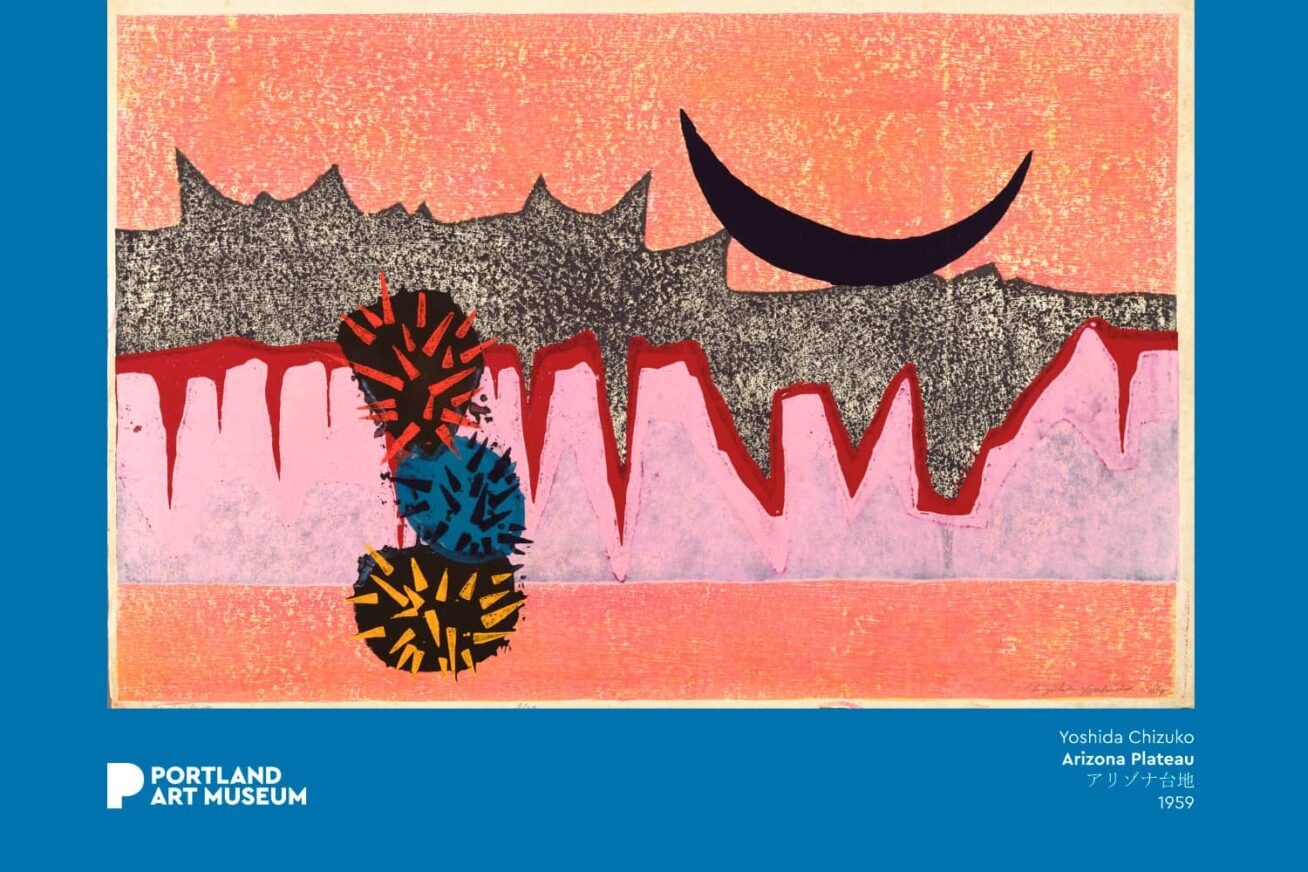
When Japanese artist Yoshida Chizuko visited the United States in 1957, she was captivated by her first experience of the desert and created a number of works responding to the arid landscapes of the American southwest. Arizona Plateau captures the silhouette of distant plateaus limned by the orange hues of dusk or dawn. Long horizontal registers convey an expansive sense of space. Three colorful, spiky round forms stacked vertically in the foreground form a cactus. The large black curve at top simultaneously suggests a crescent moon and a pair of horns on an animal skull. Both the cactus and the crescent appear repeatedly in Chizuko’s desert prints.
Chizuko experimented with variations of this work. This version is printed in vibrant pink and orange hues, but other versions show more transparent colors. Another version includes shapes printed from the ends of cardboard, one of the found materials Chizuko used in a number of prints in the 1950s.
Yoshida Chizuko (née Inoue) was an abstract artist who worked in oil painting and printmaking. Despite her fiercely creative, sixty-year-long career, her story has been overshadowed by the talented Yoshida family into which she married, and her legacy is only now becoming better understood. As a young woman painter in the 1940s, Chizuko made remarkable inroads in the male-dominated, often conservative, art establishment of midcentury Japan—winning prizes and receiving invitations to join distinguished art societies. Committed to forging her own style of radical modernism, she received mentorship and encouragement from prominent, cutting-edge Japanese artists like Okamoto Tarō and Onchi Kōshirō early in her career.
In 1953, Chizuko married artist Yoshida Hodaka, the younger son of Yoshida Hiroshi, one of Japan’s leading Western-style painters. Hiroshi founded the thriving Yoshida family atelier in woodblock printmaking, a medium that experienced enormous global popularity and commercial success in the postwar era. Chizuko adopted this new medium, which soon became the primary mode of her practice. In 1956, she cofounded the Women’s Print Association, which provided critical support for Japanese women in the graphic arts for a decade.
In January 1957, Chizuko, Hodaka, and his mother, Fujio, left Japan for a yearlong trip around the world. After a ten-month stay in the United States, they traveled to several countries in Europe, Egypt, India, Thailand, and Hong Kong before returning to Japan on January 1, 1958. The trip was an extended honeymoon, but also a working vacation: Hodaka was invited by the University of Hawai’i and University of Oregon to teach woodblock printmaking, and Fujio had an established network of contacts from her previous travels, which became the foundation for numerous demonstrations and exhibitions of the three artists’ prints. Chizuko, who was a certified teacher of the Sōgetsu ikebana school, taught flower arranging.
These travels abroad—Chizuko’s first trip outside Japan—had a profound impact on the young artist. She continued to make prints inspired by the trip several years later and to contemplate her experience of the desert. “It’s called a dead land,” she later said, “but I think the desert is alive.”
Discussion and activities
- Think of a time when you have felt moved by an unfamiliar landscape. How did you feel in this environment? What surprised or frightened or appealed to you about it? Make a list of words and phrases describing the landscape and your experience of it. Then, create a representation of the landscape incorporating found materials, such as cardboard, textured paper, and natural items. You might print or trace shapes from your materials. Think about texture and repetition, shape and color. What elements become symbols in your landscape?
- Compare Arizona Plateau to other images of landscapes during dusk and dawn. Consider how the light changes the colors and shapes we see. Do you perceive this work as portraying the morning or the evening? What elements in the work suggest one or the other to you? Create an artwork representing a place at either dusk or dawn using layered colors, transparent materials, or soft transitions to show threshold light.
- Make connections between math and landscape by exploring proportions and patterns. Chizuko’s use of repeated forms (such as cactus and moons) and layered space invites us to explore math through art. Compare several works by Chizuko in PAM’s online collections. Then, design your own landscape using simple shapes and repeat them in proportion (e.g., decreasing size to show depth). Connect this process to how ratios and geometric patterns appear in both natural landscapes and visual art.
- Consider Chizuko’s observation about the desert: “It’s called a dead land, but I think the desert is alive.” What do you think she meant? Imagine stepping into the world of this artwork. What colors, temperatures, or objects might you experience there? Compare Arizona Plateau to Claude Monet’s Waterlilies (included in the Poster Project) which he described as a “landscape of water.” What are the different feelings, sounds, and creatures you might encounter in each place? Compare each artist’s approach to the natural world? What similarities and differences do you find?
Selected sources
Yoshida Chizuko (Sept. 27, 2025 – Jan. 4, 2026). Portland Art Museum.
- View artwork from the exhibition in online collections
The Art of Yoshida Chizuko (Lecture by Dr. Jeannie Kenmotsu). JASA: Japanese Art Society of America. YouTube. Dec. 11, 2025. 59:49.
Lessons, inspired by Chizuko, developed by PAM Educator Advisory members (October 2025):
- Playing with Texture and Paint by Aleksandr Chernousov
- Poetry Workshops by Joanne Kim
- Landscapes by Alodie Lopez