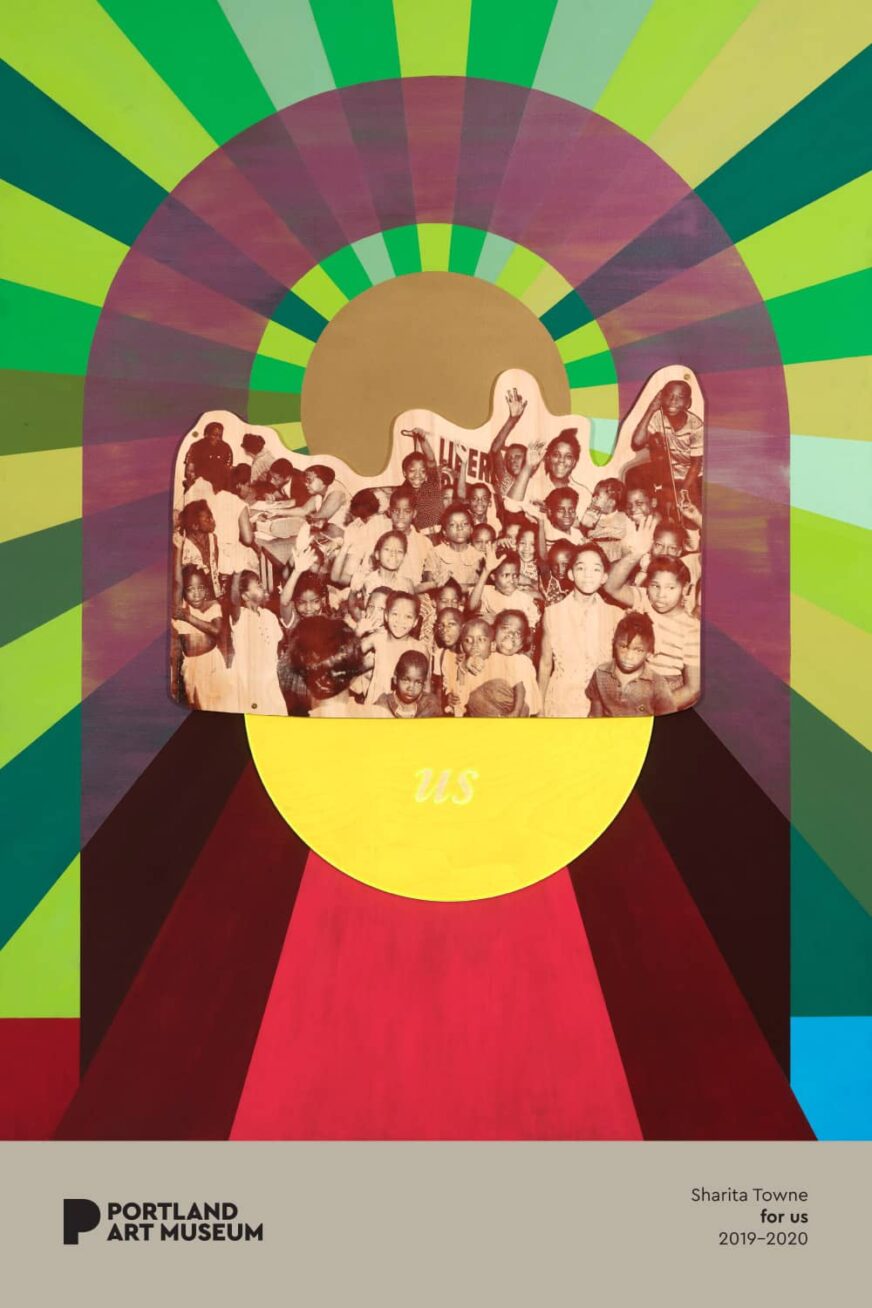
An image of community appears at the center of the painting for us. Blooming geometric rays of greens, blues, and reds beam outward from a sepia photograph screenprinted on jigsaw cut wood. The photograph portrays a crowd of Black children waving, smiling, or gazing deeply into the camera. Adults are at work behind folding tables registering voters at one of hundreds, if not thousands, of voting drives that took place in city streets around the time the Voting Rights Act passed in 1965. A deep red arch frames the group from above, with rays shooting out around them suggesting the sun, or travel through a tunnel or portal. The word “us” appears in graceful italic lettering, cut into a fluorescent yellow plexiglass half circle below them.
This painting on canvas at the Portland Art Museum transposes a mural by Towne, also titled for us, displayed on the top floor of King + Parks, an affordable housing complex at the intersection of Rosa Parks Way and Martin Luther King Jr. Boulevard in Northeast Portland. This mural, which sits above a 2nd floor mural of Rosa Parks, and a 3rd floor mural of Dr. Martin Luther King Jr., reminds 4th floor residents every day of Fannie Lou Hamer’s words, as they head out into the world and head back home every evening: “Never forget where we came from and always praise the bridges that carried us over.”
But this floor, while it celebrates Fannie Lou Hamer, does something different than the murals on the floors below. Those floors center, celebrate, and pay homage to single figures—Rosa Parks and Martin Luther King, Jr.—with wood etched portraits. This top floor mural celebrates “us”—the artist Sharita Towne’s heartfelt homage to everyday families, friends, neighbors, the young and old, in Black neighborhoods of yesterday, today, and tomorrow.
The mural was painted at the end of 2020, one year into the launch of Towne’s project a Black Art Ecology of Portland (BAEP), which she describes as a “transdisciplinary convener and resource mobilizer cultivating networks of creative care between arts workers and partner organizations.” Towne works as a muralist and printer, but she also works in community and placemaking art, though she prefers the term placestaking. Her community and place-based practice synergizes with the efforts of local organizations like Imagine Black, Albina Vision Trust, Portland Community Reinvestment Initiatives, and Self-Enhancement Inc., Adre, Prismid, Feed’em Freedom Foundation, and Black Oregon Land Trust, among many others, to rebuild and reroot thriving ecologies of Black communities in the greater Portland area.
Towne has said, “I think of the city as form.” With deep consideration for how Black art lives in neighborhoods, the for us artwork, like many of her works, is just as much about her love for historical photographs and complementary colors, as it is about how we need daily reminders to never forget that we live in a country shaped and transformed by the Black political organizing of the past, present, and future.
Discussion and activities
- Towne describes thinking of “the city as form”—meaning not only the physical spaces and structures of a city, but also how people use and relate to each other within those spaces. Walk through your own neighborhood and consider how the built environment (buildings, streets, gathering spaces) either supports or hinders community connection and cultural expression. Write a brief analysis based on your observations.
- What kind of artwork would you like to create for your community? Think of a place you see in your daily life where you would want to contribute a work of art. What ideas and feelings would your artwork convey? How might community members contribute to the process of creating the artwork? Write a plan or create a small-scale version of your artwork and discuss how your artwork relates to a specific place and community.
- Consider the lines by Fannie Lou Hamer quoted above and incorporated into the original mural. What do Hamer’s words mean to you? How do Sharita Towne’s for us works relate to Hamer’s words?
- Towne draws attention to the Civil Rights Movement as a grassroots movement. We might know the names of only prominent leaders. But major political and legal accomplishments, such as the passage of the Voting Rights Act, came about through the courage, commitment, and sacrifices of hundreds of thousands of ordinary people. Do one or both of the following activities:
- Research the history of voting rights and race in the United States and the movement and events surrounding the passage of the Voting Rights Act in 1965. Continue your research through the present moment to understand how the implementation of the Voting Rights Act has continued to change in the twenty-first century. (Students might be assigned different decades to research between 1789 and today, then collaborate to create a timeline and historical narrative.)
- Create a work of art that honors a person or group of people who are not famous, but are making a positive difference in the world. They could be someone you know or someone you’ve read about. You might create a collage inspired by Towne’s use of multiple media in her work. Use paint, photography, printing, or any materials and colors that speak to you.
Special thanks to Sharita Towne for generously contributing writing and suggesting sources for this poster.
Selected sources
APEX: Sharita Towne & A Black Art Ecology of Portland, Exhibition at the Portland Art Museum, July 21, 2021 – Oct. 30, 2022.
Artist Talk: Sharita Towne, Portland Art Museum, May 16, 2019. (Discussing Mickalene Thomas, Do I Look Like a Lady?)
Sharita Towne: On ‘Black geography’ and community-based art in Portland | Oregon Art Beat, Oregon Public Broadcasting, YouTube, 8:29, January 27, 2021.
Emilye Crosby and Judy Richardson, “Voting Rights Act: Beyond the Headlines,” Civil Rights Teaching. Accessed August 13, 2025.