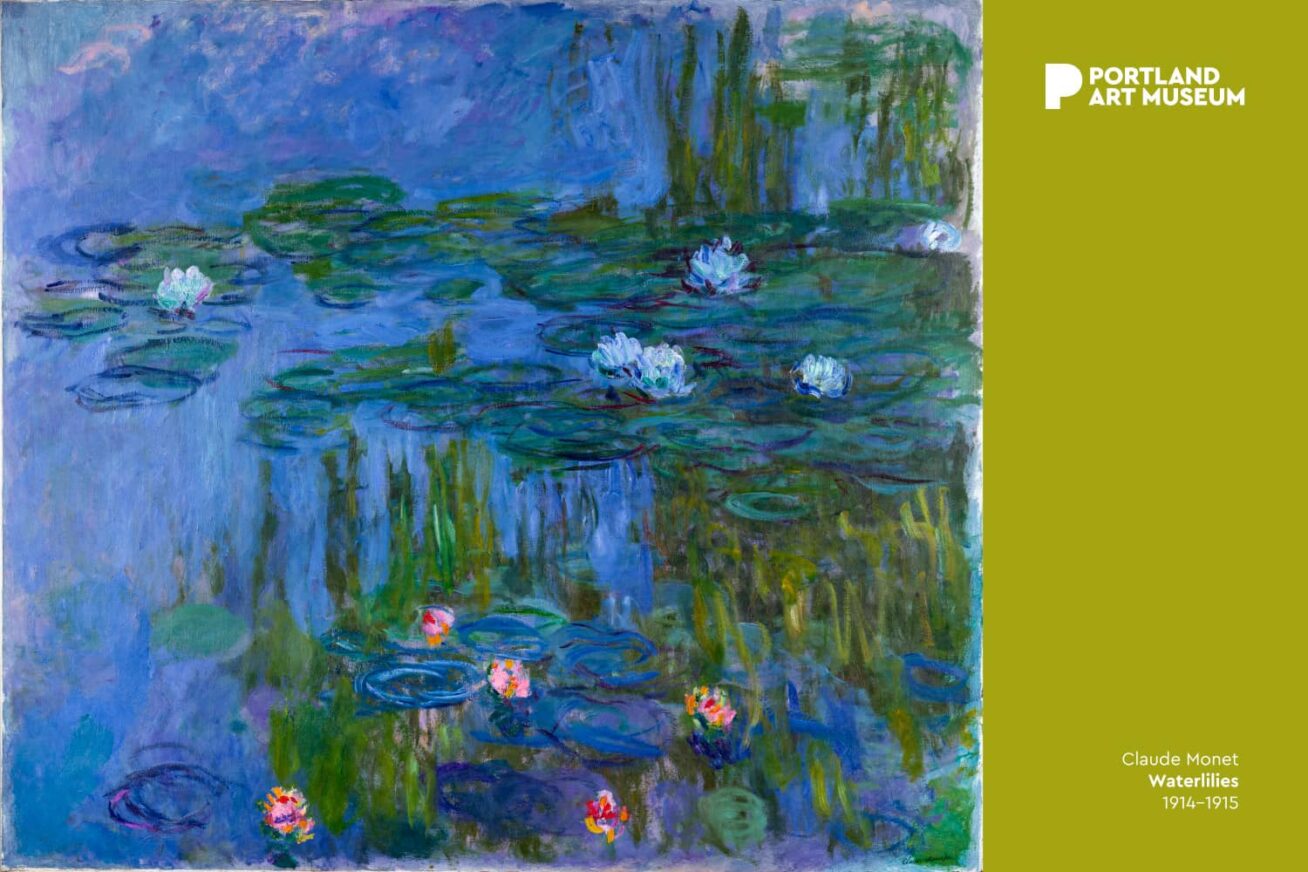
Monet’s large, mesmerizing painting shows waterlilies floating on a pond, among the reflections of willow branches and clouds. One of the most-loved works in the Museum’s collection, it was part of a series of over 250 paintings the artist made of the waterlilies in his Japanese-style garden at his house in Giverny, France, between the late 1890s and his death in 1926. Although it is a landscape painting, we don’t see any land—in fact, he called his waterlily paintings “landscapes of water.” Leaving out the shore and the horizon, he leaves us staring into the water, which we don’t really see either, just the reflections of what is overhead.
Monet was one of the leaders of the influential Impressionism movement in French art that officially began with an 1874 exhibition in Paris, when a critic disparaged Monet’s 1872 painting Impression, Sunrise as being “Impressionist.” Other critics heralded these artists for painting modern life as it was and showing what was directly in front of them. In contrast to the prevailing Neoclassical painters who illustrated stories and myths from the distant past in a polished, smooth style, the Impressionists painted in natural, outdoor settings (in French, en plein air). Their thickly painted sketch-like works were typically completed in one sitting on small portable canvases, so as to embody unmediated reality.
Beginning in 1890, Monet started painting in series, showing haystacks in country fields in different seasons, at different times of day and in different weather conditions, to show that the only thing that was constant about nature was change. He went on to complete a series of poplar trees, the cathedral in Rouen, and Waterloo Bridge in London, among other subjects. Monet moved his family to rural Giverny in 1883 to secure cheaper rent and more studio room, but his first eight exhibitions did not prove profitable and were ridiculed in the press. By 1890, he had become successful enough to buy the property and started building a closed Norman-style formal garden. Three years later, he acquired more land along a stream and diverted it to create a pond surrounded by Japanese-style gardens with a bridge. He then sought out rare, new, hybrid breeds of waterlilies for the pond and began his long series of paintings.
Monet had begun collecting Japanese prints, and decorated his main-floor dining room and the adjacent rooms with prints of landscapes, actors, and courtesans, all subjects that were popular among Japanese collectors. These prints were named “Floating World” after the entertainment district at the water’s edge in Edo (Tokyo) harbor, and often depicted beautiful women along with birds, flowers, and landscapes in refined compositions overlaid with poetic texts. This love of beauty, nature, and flowers inspired Monet to paint his own waterlily series.
Monet’s ambition to create Grandes Décorations, a series of large waterlily paintings, gained traction during World War I after he proposed the project to the French prime minister as a memorial to the dead of the First World War. It was installed just after his death in 1926, in three, large, oval-shaped and skylit galleries in the former orange-tree greenhouse in front of the Louvre Museum in Paris. Portland Art Museum’s painting, completed in 1915, represents the somewhat abstract style of those grand paintings, in which some circles on the water seem to be calligraphic marks rather than lily pads or ripples from drops of water. Monet claimed not to paint the land and objects he saw, but rather the enveloppe—the enveloping air that surrounded them. He still worked outdoors, as seen in a 1915 photograph in which he is working on the Portland painting in his gardens. He never sold the painting and so did not need to sign it; it hung in his son’s dining room for decades until its sale in 1959. Monet had wanted viewers to see the raw paint, without shiny varnish on top, but Portland’s painting was inadvertently varnished during a restoration just after it was bought. A 2024–25 conservation project involved removing all the now-darkened synthetic varnish and uncovered the painting as the artist intended us to see it.
Discussion and activities
- Look at this picture from far away, then from very close. Describe what you notice in each position, paying particular attention to brushstrokes and texture. How does your perception of the image change? Repeat this activity with the original painting at the Portland Art Museum.
- Monet attempted to paint the enveloppe—the air surrounding the land and objects he saw. As you look closely at the image, where do you see evidence of the enveloppe? What would the air around this pond feel like? Imagine stepping into the world of this painting. Describe your experience through each of your five senses. What might you see, hear, touch, smell, and taste?
- Use this painting as a background habitat for your own creatures. Make at least three who could live in this painting. Are they camouflaged to blend in? Or are they in contrasting colors that stand out?
- Create your own artwork en plein air. Go outdoors and choose a scene that interests you, such as a building, street, woods, or pond. Draw or, for an extra challenge, paint the scene. What feels different about making art outdoors?
- Extend this experience by creating a series, as Monet did. Depict the same scene at different times of day or over different months and seasons. What variations do you notice in light, shadow, and color? How will you convey those in your artwork?
- Compare Monet’s Waterlilies to the woodblock prints by Japanese artists presented in the Portland Art Museum exhibition Monet’s Floating Worlds at Giverny (images available in online collections). There are many differences in style and subject matter. What similarities or connections can you find?
Selected sources
Monet’s Floating Worlds at Giverny: Portland’s Waterlilies Resurfaces, Portland Art Museum exhibition (March 1 – August 10, 2025).
Unveiling Monet’s Waterlilies: Conserving a PAM Masterwork, Portland Art Museum (includes videos and photos on conservation process).
The Water Lilies by Claude Monet, Musée de L’Orangerie
Lessons, inspired by Monet’s Waterlilies, developed by Gena Fields, PAM Educator Advisory member (May 2025):