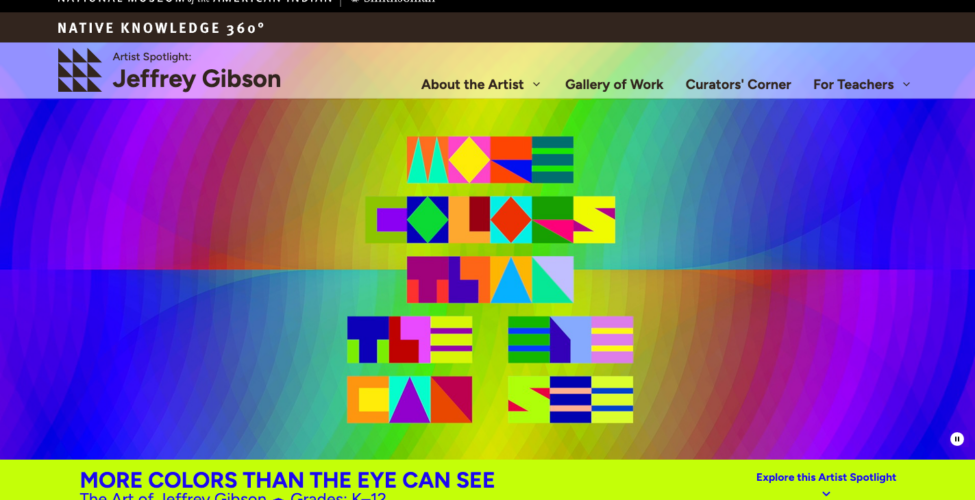
The Portland Art Museum announces a groundbreaking new education initiative, MORE COLORS THAN THE EYE CAN SEE, a central extension of artist Jeffrey Gibson’s historic solo exhibition for the U.S. Pavilion at the 60th Venice Biennale. Co-commissioned and co-organized by the Portland Art Museum (PAM) and SITE Santa Fe, in cooperation with the U.S. Department of State’s Bureau of Educational and Cultural Affairs, this project ensures that the exhibition’s vision is not confined to Venice. Instead, it transforms the Biennale exhibition’s themes into a living curriculum for K-12 classrooms across the country, bridging the gap between the global art stage and local education.
This vision was brought to life through a multiyear collaboration between a cohort of ten dedicated educators, the Smithsonian National Museum of the American Indian (NMAI), and Jeffrey Gibson himself. Together, they developed a suite of 14 new interdisciplinary lessons that move far beyond traditional art room boundaries. By situating Indigenous art within a broad U.S. and global context, these resources fill a critical gap in contemporary education, offering students a way to engage with the complexity and vibrancy of modern Native life.
Rather than treating art as a static object to be studied, the curriculum uses Gibson’s work as a lens to explore the world. Students are invited to investigate the deep connections between Identity and Representation, looking at how symbols, garments, and color function as tools for storytelling. The lessons also champion the concept of Creative Sovereignty, empowering young people to see how Indigenous artists define their own spaces within the global art world. By bridging the gap between contemporary art and subjects like math, history, and social studies, the initiative encourages a more holistic way of thinking.
While Gibson’s work has dazzled audiences on the international stage in Venice, this extension ensures that its true impact is felt in local communities. These high-quality resources are now freely available to educators and the public through the Smithsonian’s National Museum of the American Indian Native Knowledge 360° (NK360°) digital platform and the official Jeffrey Gibson 2024 Venice Biennale website.