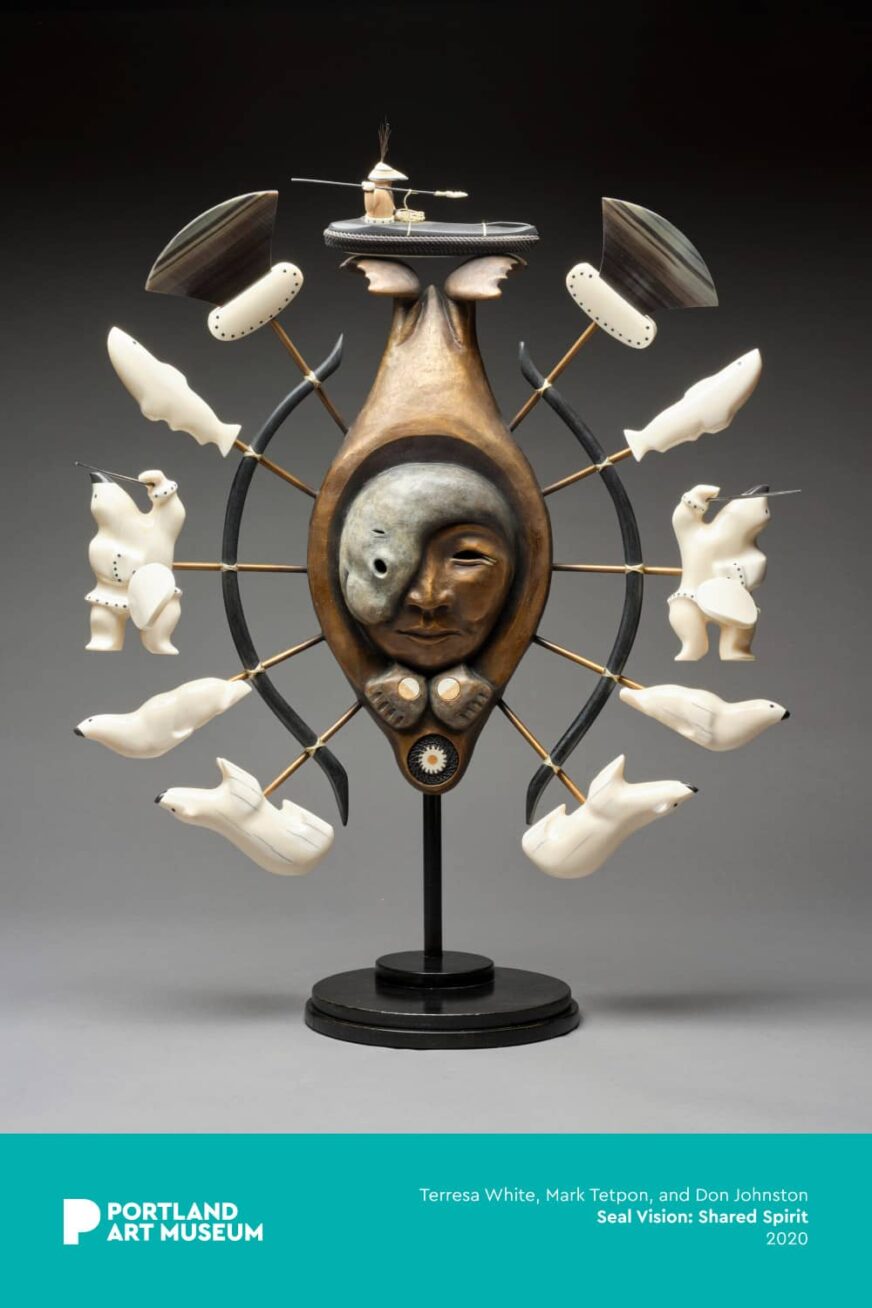
Seal Vision: Shared Spirit is a wondrous mixed media sculpture that celebrates the interconnected lives of seals with the people and animals of the Far North, and their relation to the spiritual world. Rich in cultural knowledge and storytelling, this striking, joyous sculpture is the result of a collaboration between Terresa White (Yup’ik), Mark Tetpon (Inupiaq), and Don Johnston (Qagan Tayagungin Aleut).
With delicately intricate characteristics and complex layers, Seal Vision: Shared Spirit highlights the artistic excellence of each artist collaborator. The central shape was created by White in bronze and resembles a seal’s body as viewed from below with its flippers at the top. The woman’s face in the center is also transforming from human to seal. The mask form is surrounded by walrus ivory carved into pairs of seals, polar bears, dancers, fish and ulus (versatile knives used by Yup’ik and Inuit women to carve meat or blubber and scrape hides) by Tetpon. The work is topped by a hunter carved from fossilized walrus ivory sitting in a baleen basketry canoe created by Johnston.
This sculpture echoes the format of Yup’ik dance masks that Yup’ik dancers wear during their ceremonies. Most dance masks relate to cultural stories that help teach, heal, and uplift their communities.
The “shared spirit” of the sculpture’s title speaks to the Alaska Native cultural knowledge that the three artists share across their distinct tribal identities: Yup’ik, Inupiat, and Aleut (pronounced you-pik, i-noo-pee-aht, and a-lee-oot). White writes:
We share Far North stories of the masked dancer transforming into seal, of the first seal springing to life from the severed fingers of Sea Woman, of the young boy who is sent to live in the underwater home of seals to learn their ways and so become a great hunter… We are told that seals know the ways of humans, are sensitive to our thoughts and actions, and can hear our words. Caution, care, and respect in the treatment of seals and of other human and non-human people is central to our understanding of living a good life.*
Connection, reciprocity, and respect are integral to the story of this mask. The moral storytelling teaches its viewers how to treat all beings including those in the animal world while emphasizing the significant and historical relationship between humans and seals.
White describes transformation as central to her artistic practice and to sustaining cultural knowledge across time and place. She writes, “I am inspired by Yup’ik stories of transformation and the Yup’ik understanding of the interrelationship and spirit of all beings including human and animal people, water and sky people, river, sea, and rock, and beings we cannot see. My work transforms me, brings me closer to my Granny’s ways of knowing and to the Alaskan village life she left as a young woman with my mother.”* White was raised in rural Rainier, Oregon and lives and works today in Portland.
Discussion and activities
- Take some time to look closely at the artwork as it appears on the front of the poster. What draws your attention first? How do your eyes travel around it? Which shapes and figures can you identify and which are you unsure of? As you look at the detail photos on the back of the poster, how does your perception change? What more can you find? Choose one element of the work and sketch it.
- Consider the overall shape of the sculpture. How would you describe it to someone who hasn’t seen it? How might the parts relate to one another?
- What can you learn about the Indigenous cultures and natural environment of the Far North just by looking at this sculpture? How do the work’s materials contribute to its meaning?
- Think about animals, plants, or natural features that are important to your community or to you personally. What makes them a meaningful part of your world? How do you relate to them? How might you represent those relationships in an artwork? Sketch a design or create the artwork itself.
- Terresa White writes about transformation as central to Yup’ik stories and to her own artistic practice. Think of a time when you felt transformed or witnessed a transformation in someone or something else. Or imagine a transformation you would like to experience. Write a story about it. (This project could be done by individuals or groups and could be extended with illustrations.)
* Terresa White, “Transformations and Other Visions,” www.terresawhite.com/About.
Selected sources
“Alaska Native Art: Stories of Healing Through Transformation,” Five Oaks Museum, December 2021.
Daily Art Moment: Terresa White, Mark Tetpon, and Don Johnston, Portland Art Museum blog. February 18, 2021.
“A Sculpture Unveiled, A Vision for the Future,” NAYA Family Center blog about Terresa White’s public art installation, Raven’s Welcome, in Portland’s Cully neighborhood. January 1, 2025.
Raven Makes, “Terresa White, Award-Winning Yup’ik Sculptor,” August 25, 2018. Raven Makes Gallery blog.
Raven Makes Gallery: Mark Tetpon, Inupiat Artist, Alaska
Raven Makes Gallery: Don Johnston
Steinbrueck Native Gallery: Don Johnston
Maps and information from Stonington Gallery: Contemporary Masterworks of the Northwest Coast:
- Aleut by the Aleut Corporation
- Central Yup’ik by Alaska Native Heritage Center
- Inupiaq by Alaska Native Heritage Center
“Unangax̂ History and Culture,” Aleutian Islands World War II, National Park Service.
(note: Unangax̂, which translates roughly to “seasiders,” is the self-given name of the people who inhabit the Aleutian Islands, also known as the Aleut.)
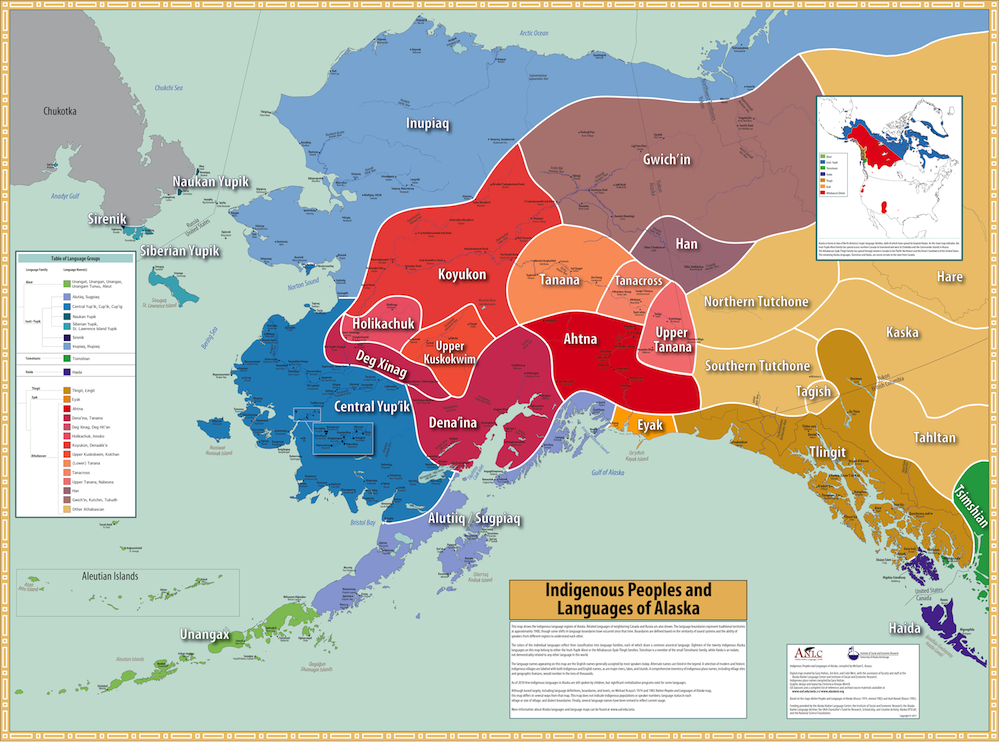
Map of Indigenous Peoples and Languages of Alaska, Copyright © 2011
Alaska Native Language Center, University of Alaska Fairbanks
Institute of Social and Economic Research, University of Alaska Anchorage